25–50 kg Range
Configure heavy-bag weighing and filling for common industrial open-mouth bag formats.
 Request a Quote
A belt-fed weighing, filling and closing solution for compatible powders, blends and bulk materials in 25–50 kg open-mouth bags.
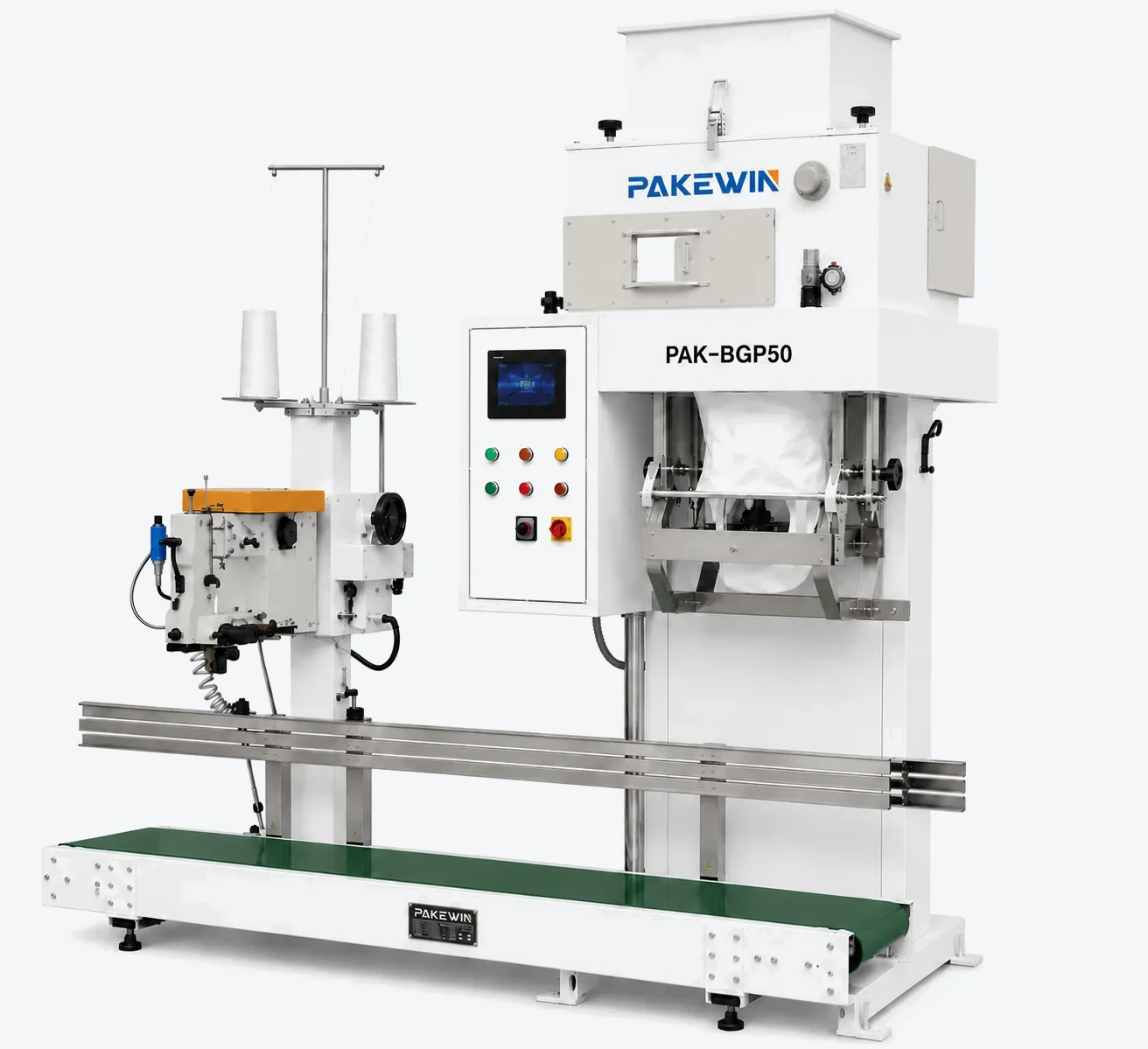
Heavy-Bag Belt Feeding
The PAK-BM50 uses belt feeding to transfer product steadily into the weighing and filling process. It is intended for compatible powders, blends and other bulk materials where a controlled feed path can support stable bagging. The standard specification combines weighing, filling and bag-closing integration with SS304 construction.
Material behavior determines the final machine configuration. PAKEWIN reviews bulk density, particle size, moisture, flowability, dust and segregation risk before confirming belt dimensions, feeding stages, bag support and dust-control interfaces.
Configure heavy-bag weighing and filling for common industrial open-mouth bag formats.
Move suitable materials through fast and fine feeding stages with controlled belt transfer.
Connect bag sewing, conveying, coding, inspection and palletizing according to the project.
Operating Process
The product enters the supply hopper from upstream storage or conveying. Hopper geometry and agitation requirements are selected for the actual material.
The belt feeder transfers product through coarse and fine feeding stages. The weighing controller reduces the feed rate as the target weight approaches.
An operator presents an open-mouth bag to the filling spout. The bag is supported and clamped before the weighed material is discharged.
The filled bag is conveyed to sewing or another compatible closure, then can continue to coding, inspection and pallet handling.
Technical Specifications
These values support initial comparison. Final performance and configuration must be confirmed from representative product, bag and site data.
Application Engineering
Provide the product name, bulk density, particle size distribution, moisture, temperature and flowability. Samples or videos can help identify bridging, sticking or dust concerns.
State the target bag weight, acceptable tolerance and required bags per hour. The relationship between speed and accuracy is confirmed during engineering and testing.
Provide bag material, dimensions, mouth width and closure method. Woven, paper and compatible plastic bags may need different supports, conveyors and closing equipment.
The system can be integrated with dynamic checkweighing, metal detection and robotic palletizing when suitable for the product and process.
Frequently Asked Questions
The PAK-BM50 is intended for compatible powders, blends and bulk materials that can be controlled by a belt-feeding system. Final suitability depends on bulk density, particle size, moisture, flowability, dust behavior and segregation risk.
The specified packing range is 25–50 kg. The final operating range should be confirmed using the actual material, target accuracy, bag dimensions, bag-mouth construction and closing method.
The stated capacity is up to 200 bags per hour. Actual output depends on target weight, material flow, feeding distance, operator handling, bag closing and downstream conveying.
Belt feeding can be considered when a material needs a steady, controlled transfer path and is not best served by a simple gravity feed. Representative product testing is recommended before final configuration.
For smaller 5–25 kg flour and compatible powder bags, compare the PAK-BP25 powder packing machine.