Automatic Bag Handling
Coordinate empty-bag feeding, opening and positioning to reduce manual bag placement during continuous production.
 Request a Quote
Automatic open-mouth bag feeding, weighing and filling for compatible granular products in 5–25 kg bags, designed for higher output and reduced repetitive handling.
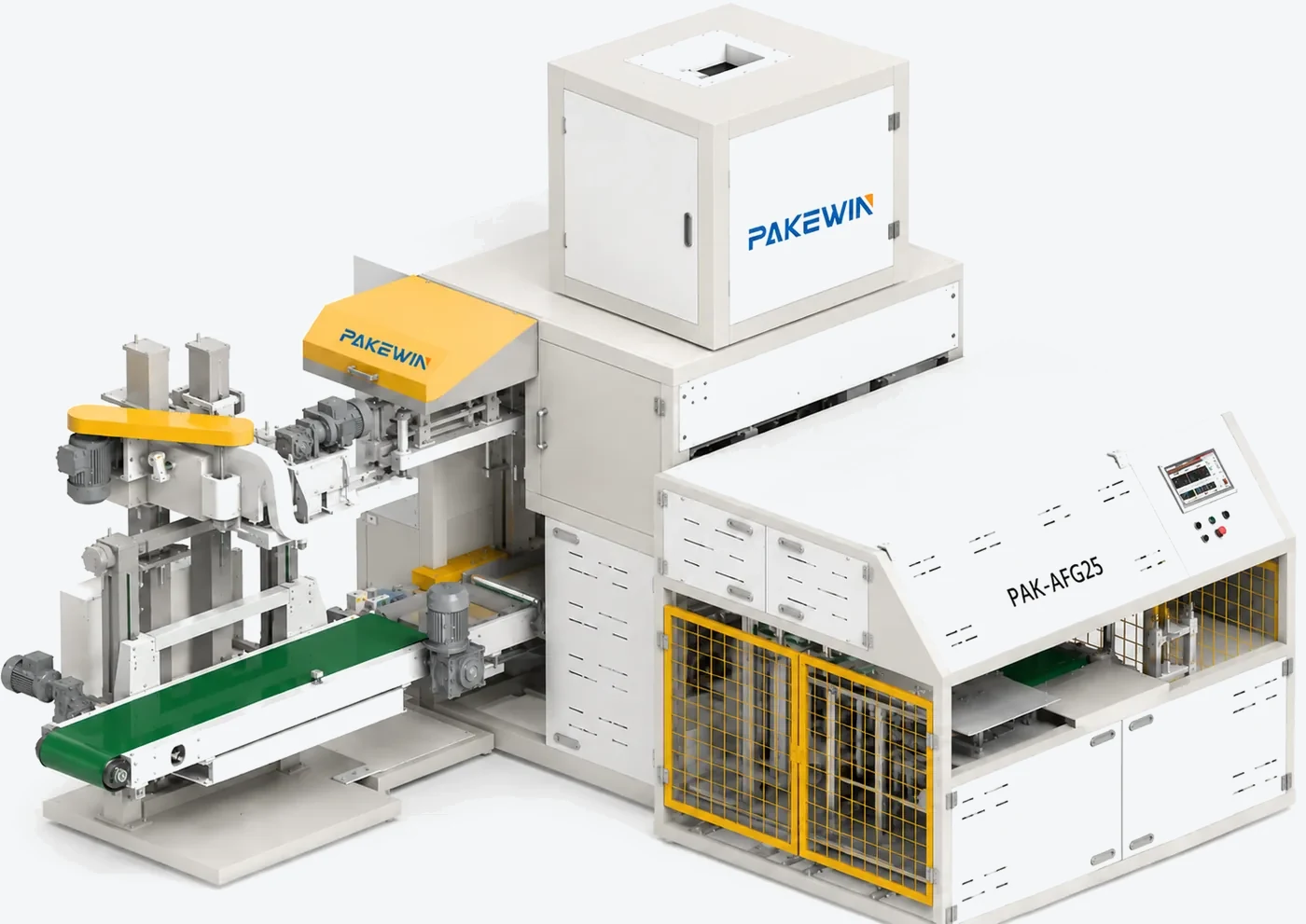
Fully Automatic Open-Mouth Bagging
The PAK-AFG25 is designed for production lines where manual presentation of every empty bag limits output or creates repetitive labor. The system coordinates empty-bag handling with controlled weighing and filling before the filled bag continues to its closing process.
PAKEWIN configures the project around the product, bag specification, target weight, line rate and factory layout. Sewing, heat sealing, coding, inspection and palletizing are selected as separate line functions according to the finished package.
Coordinate empty-bag feeding, opening and positioning to reduce manual bag placement during continuous production.
Use controlled motion and weighing sequences to support repeatable bag handling and filling.
Connect bag closing, conveying, inspection and palletizing equipment around the required production process.
Automatic Workflow
The exact sequence depends on the bag and closing method. A typical PAK-AFG25 project follows these stages.
Premade open-mouth bags are loaded into the bag magazine in the orientation and quantity defined for the application.
The bag-handling system picks, opens and presents each bag to the filling spout. Bag stiffness, surface and mouth shape affect handling reliability.
The product is dosed toward the target weight and discharged into the correctly positioned bag.
The filled bag transfers toward sewing, heat sealing or another compatible closure, then continues to inspection and end-of-line handling.
Technical Specifications
Standard model values are shown below. Final performance and line scope must be confirmed with the product, bag and closing method.
Engineering Fit
Bulk density, particle size, moisture, dust and flow consistency determine the feeding method and weighing cycle. Representative samples are recommended.
Automatic bag feeding requires controlled bag dimensions, mouth opening, stiffness, surface friction and stacking. Send bag samples before final acceptance testing.
Woven, paper and compatible plastic bags may require sewing, folding, heat sealing or combined treatment. The closure must match the bag construction and product.
The stated 600–800 bags/hour cannot be evaluated in isolation. Product supply, bag closing, inspection, conveyor accumulation and palletizing must support the required sustained rate.
Line Integration
Add dynamic checkweighing or metal detection when the finished package requires in-line verification.
Connect conveyors and an EC-171 robotic palletizing system to reduce repetitive finished-bag handling.
Send the material, target weight, bag drawing and samples, required bags per hour, closure, factory layout, electrical standard and destination-country requirements.
Agree on representative materials, bags, operating conditions, good-output rate and test duration before production testing.
Frequently Asked Questions
The PAK-AFG25 is intended for compatible free-flowing granular materials such as rice, grain, beans and similar products. Product samples and flow data are required to confirm the feeder and achievable performance.
The specified packing range is 5–25 kg. The bag material, dimensions, mouth shape and closing method must be checked before final configuration.
The stated capacity is 600–800 bags per hour. Actual sustained output depends on target weight, material flowability, bag specification, bag feeding, closing time and downstream equipment.
A project can include empty-bag feeding, bag opening and positioning, weighing, filling, bag-mouth handling, sewing or sealing, takeaway conveying and interfaces to inspection or palletizing equipment. Final scope is application specific.
See the semi-automatic versus fully automatic bagging guide or explore complete packaging lines.