
Send your product, bag and capacity requirements
The short answer
Choose a 25 kg automatic bagging machine by matching the product, empty bag, closing process and required accepted output—not by bag weight alone. A system suitable for free-flowing rice may require a different feeder and dust-control arrangement for flour. Automatic bag pickup also depends on the consistency of the empty bags.
Before comparing prices, send suppliers the same product information, representative bag samples, capacity target and factory layout. Ask each supplier to identify what is included, what requires testing and what remains your responsibility.
1. Start with the material, not the machine model
Record bulk density, particle size, moisture, flowability and dust generation. For grains, discuss breakage sensitivity and stable upstream feeding. For powders, discuss aeration, bridging, settling and dust extraction. Product-contact materials and cleaning access should match the actual food-production requirements.
Do not assume one feeder handles every ingredient equally well. Request trials when a product is sticky, poorly flowing or easily aerated. Where combustible dust may be present, provide material safety information and arrange a qualified assessment of the installation; a generic machine quotation does not establish hazardous-area suitability.
2. Verify the actual empty bag
Specify material, width, length, gussets, mouth construction, liner and closure requirements. Woven polypropylene, paper and plastic-film bags can need different gripping and closing arrangements. Send samples from the bag supplier intended for production—not just a photograph.
A bag that fills reliably with an operator may not separate or open consistently in an automatic magazine. Ask for a trial covering bag pickup, opening, clamping, filling and transfer. Define how failed pickup is detected and recovered, and whether liner positioning needs additional equipment.
3. Convert the production target into accepted bags per hour
For an illustrative target of 10 tonnes per hour in 25 kg bags, the required accepted output is 10,000 ÷ 25 = 400 bags per hour. This is a planning calculation, not a performance claim for a PAKEWIN model. Allow for normal stops, bag replenishment, cleaning and rejects when agreeing on the nominal capacity needed.
Ask whether the quoted rate describes an isolated filling cycle or a complete line with the actual closing and inspection process. A fast filler cannot deliver the target if bag supply, sewing, checkweighing or palletizing creates a persistent bottleneck. Define the trial duration, test conditions and accepted-output calculation in writing.
4. Match closing and inspection to the package
Sewing, heat sealing and a combined liner-sealing and sewing process are not interchangeable. Select the method according to bag construction, product protection and distribution requirements. Discuss dust at the bag mouth and whether the sealing surface remains clean during filling.
Where required, specify checkweighing, rejection and contamination inspection. Detector suitability must be checked against the product, package material, aperture and required detection performance. Do not treat every inspection module as standard equipment included in the basic price.
5. Define changeovers and factory interfaces
If production will alternate between 25 kg and 50 kg bags, confirm the material-and-bag envelope for both formats. Separate stored recipe settings, manual adjustments and replacement parts. Agree how changeover time is measured; a recipe button alone does not adjust every mechanical part or clean the machine.
Share ceiling height, maintenance clearance, feeding height, conveyor direction, electricity, compressed-air quality and available dust extraction. Include guarding, emergency-stop interfaces and operator access in the layout. Confirm destination-country requirements and the responsible party for final integration.
6. Compare complete quotation scopes
Ask for an itemized scope: feeder, weighing system, bag magazine, closing equipment, conveyors, inspection, guarding, control interfaces, spare parts and documentation. Confirm whether freight, installation, commissioning, training and local electrical work are included or excluded.
For factory acceptance testing, use representative product and production bags. Agree on weight tolerance, accepted output, bag-handling reliability, closing quality and fault recovery. Put test conditions, responsibilities and any unresolved sample trials into the contract rather than relying on a demonstration video.
Which PAKEWIN configuration should you discuss?
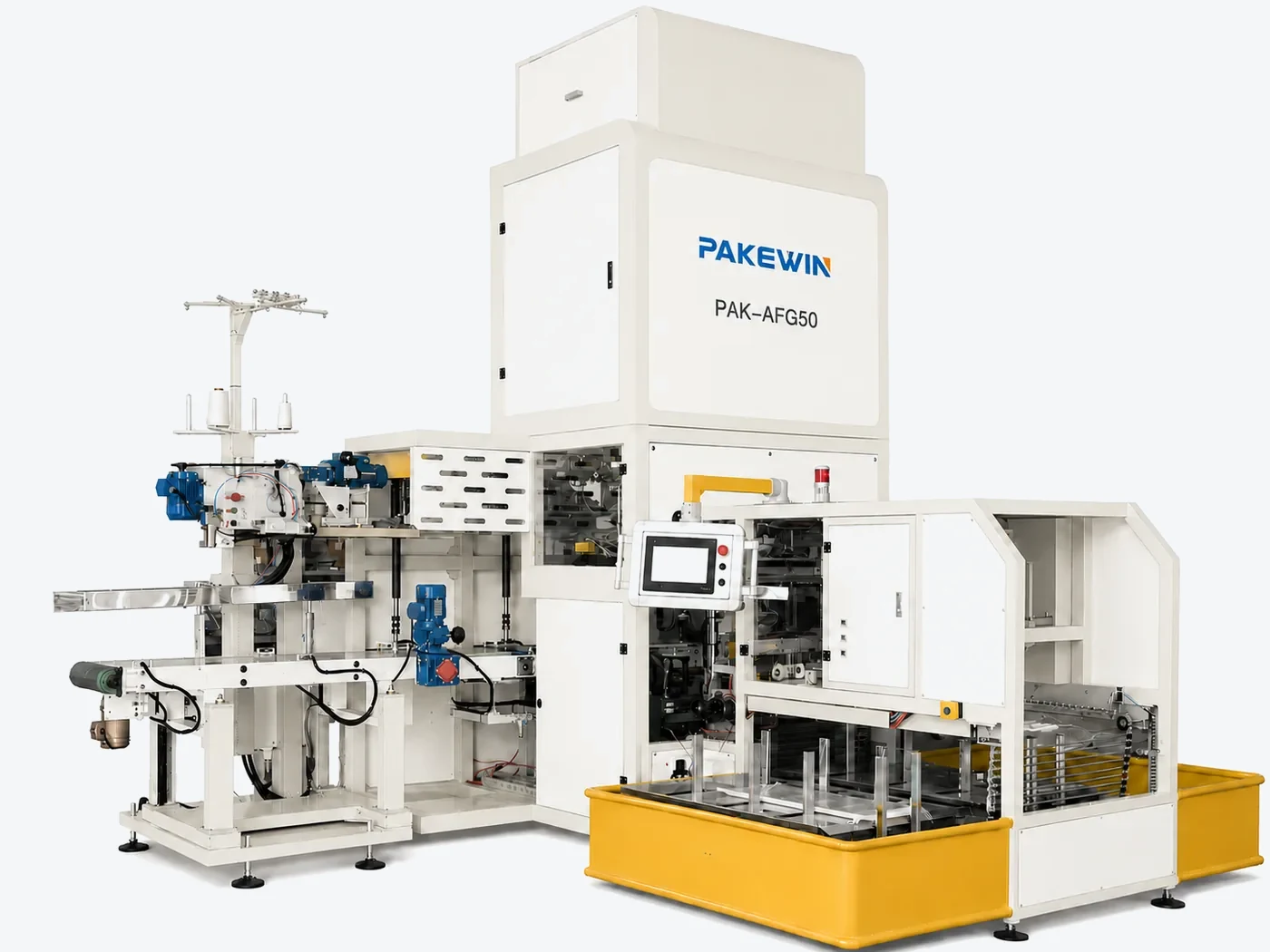
For compatible rice and free-flowing granules in large bags, discuss PAK-AFG50. For compatible powders, discuss PAK-AFP50 and the required feeding and dust-control arrangement. These are different application paths, not a promise that either model handles every material or bag.
Final suitability, sustained output and accessory scope require review of your product, bag samples and layout. If the budget or production pattern does not justify automatic bag placement, include a semi-automatic option in the comparison.
Send these details for a useful technical quotation
Provide: product name and characteristics; target bag weight; bag material, dimensions and samples; required accepted bags per hour; closing and inspection needs; factory layout and utilities; installation country; and planned future formats.
PAKEWIN can review these requirements and propose a suitable configuration. Tell us which items are essential at startup and which are future options, so the quotation can distinguish the initial machine from a complete integrated line.