Secondary overbagging for finished vacuum rice bricks
Secondary overbagging for finished vacuum rice bricks; designed for approved 0.5–5 kg six-side packs
 Request a Quote
Operator-assisted outer-bag packaging for finished six-side vacuum rice bricks, with automatic bag opening, loading, heat sealing and discharge after the outer bag is presented.
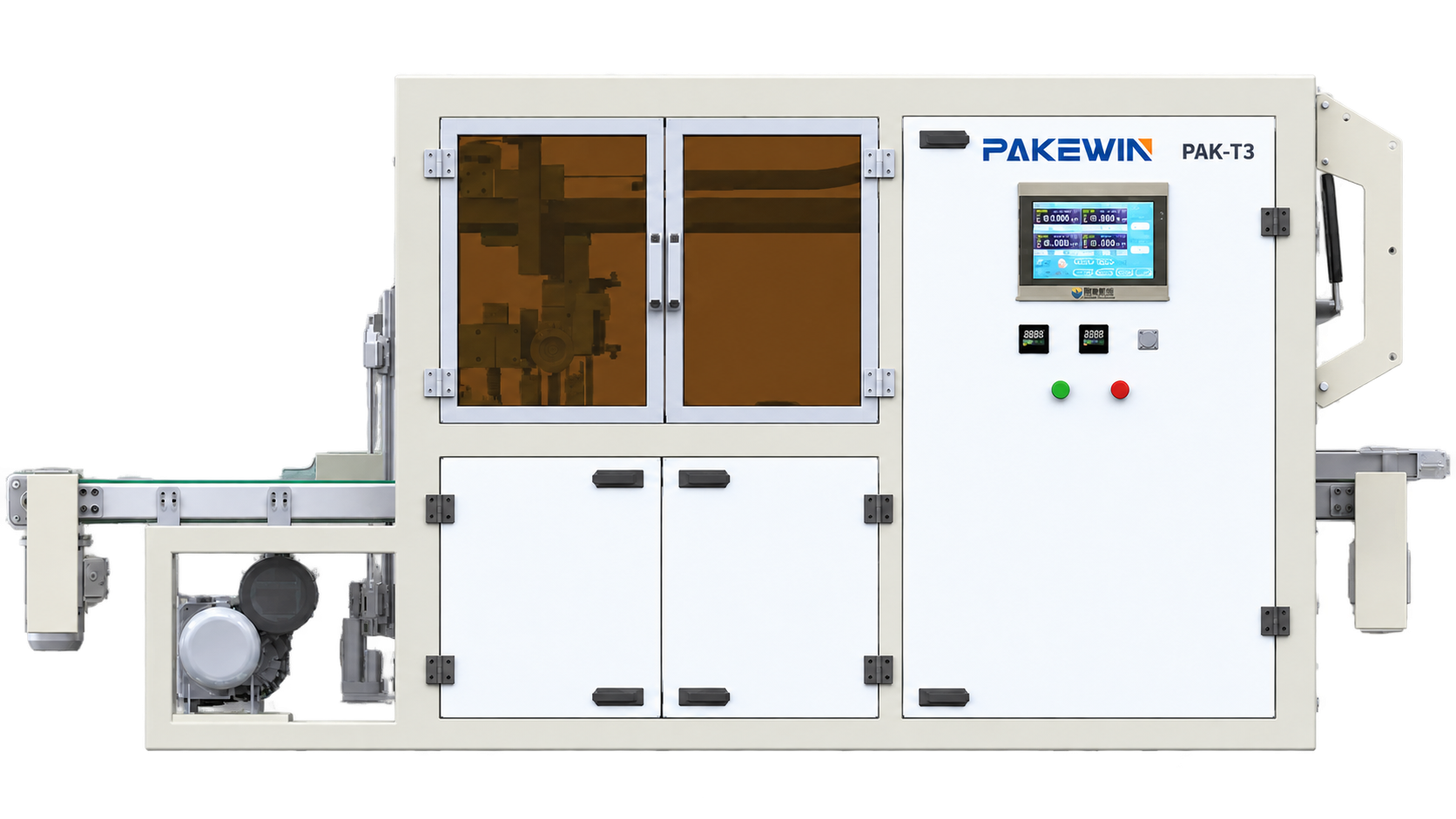
Secondary Bagging · 0.5–5 kg Vacuum Rice Bricks
The PAK-T3 is a semi-automatic secondary bagging machine for finished six-side vacuum rice bricks. It does not weigh, vacuum or form the primary rice pack. An operator presents the approved outer bag, after which the machine opens the bag, loads the accepted rice brick, heat-seals the outer package and discharges it. This operating boundary distinguishes it from the fully automatic PAK-RP9.
Published values are reference specifications, not a guarantee for every material or package. PAKEWIN confirms the final configuration through application review and representative sample testing.
Secondary overbagging for finished vacuum rice bricks; designed for approved 0.5–5 kg six-side packs
Handle and standard outer bags; compatible with approved four-side-sealed plastic bags with or without handles
Operator-assisted automatic cycle; manual outer-bag placement followed by automatic bag opening, loading, heat sealing and discharge
Applications
Add a retail outer bag to accepted 0.5–5 kg six-side vacuum rice bricks.
Run approved four-side-sealed outer bags with a handle after pickup, opening and sealing trials.
Use compatible four-side-sealed plastic bags without handles for retail or distribution packs.
Store multiple operating recipes and change formats when the inner pack, outer bag and tooling have been approved together.
Technical Specifications
Confirm voltage, utilities, dimensions, output and acceptance criteria for the destination and final application.
Operating Sequence
An accepted six-side vacuum pack arrives from the upstream packing process.
The operator places an approved premade outer bag at the loading position.
The machine opens the bag and inserts the finished vacuum rice brick.
The outer bag is closed and the completed pack exits for inspection, case packing or palletizing.
Project Information
Provide real inner-pack and outer-bag samples, target weights, pack firmness, surface friction, bag material, handle style, sealing layer, accepted output and line layout. Maintain at least 5 mm internal clearance around the rice brick. The source specification calls for approximately 80 mm from the brick bottom to the bag mouth for packs up to 2.5 kg and 90 mm for 5 kg packs; final dimensions must be verified with samples before manufacture.
Related Equipment
PAK-RP9 fully automatic rice brick overbagging machine · PAK-AVS5 automatic six-side vacuum machine · Vacuum packing machine range
Frequently Asked Questions
It places an already finished 0.5–5 kg six-side vacuum rice brick into a separate retail outer bag. It does not create the primary vacuum pack.
The PAK-T3 is semi-automatic and requires an operator to present the outer bag. The PAK-RP9 is intended for fully automatic outer-bag feeding and handling.
The listed formats are four-side-sealed plastic outer bags with or without handles. Real bags must be tested for opening, loading and heat-seal compatibility.
Allow at least 5 mm internal clearance around the rice brick. The required distance to the bag mouth also depends on pack weight and must be confirmed with actual samples.
The stated range is 600–700 bags per hour. Sustained accepted output depends on operator rhythm, pack dimensions, bag opening, loading, heat-seal time and downstream handling.