
October 2, 2026 | Robotic Palletizing | By PAKEWIN Engineering Team
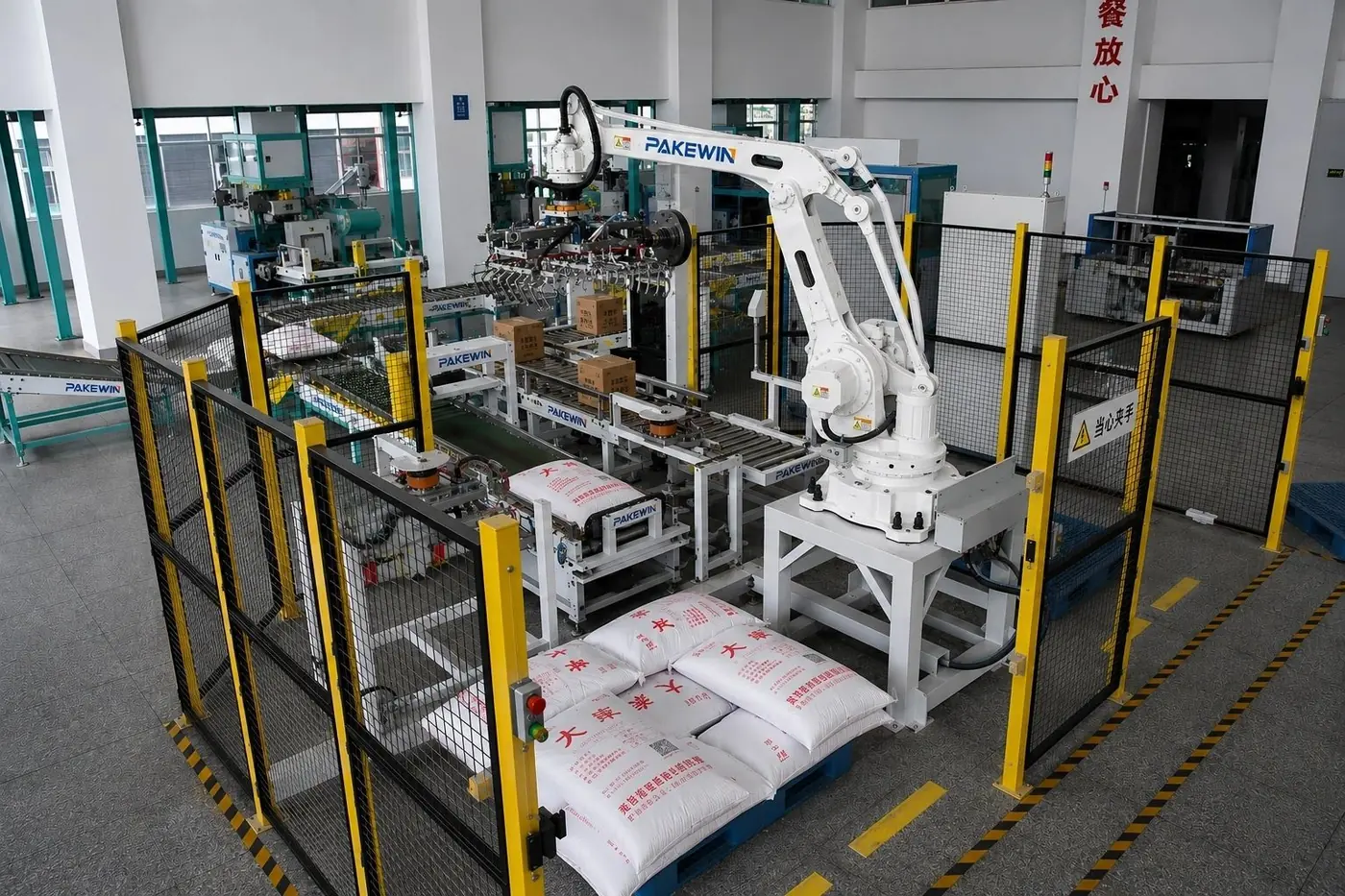
Planning to automate bag stacking? Send your bag weight, filled dimensions, output and pallet pattern for a PAKEWIN application review. Send Your Packaging Requirements
Quick Answer
A robotic palletizing system for 25 kg bags should be selected from the complete production task: bag weight and dimensions, actual bags per minute, gripper weight, pallet pattern, stacking height and pallet exchange method. Robot payload alone does not establish whether a system will handle your bags reliably.
For example, a packing line producing 600 bags per hour sends one bag downstream every six seconds on average. If the robot picks one bag at a time, it needs to complete at least ten loaded placement cycles per minute during normal running. The complete cell must also accommodate bag presentation, layer changes, interruptions and pallet exchange. A catalogue cycle rate is a starting point, not an accepted production rate.
Why Bag Palletizing Is a Timely Automation Decision
PMMI's August 2026 robotics update identifies productivity, cost reduction and quality as drivers of robotics investment in packaging and processing. Its report summary also emphasizes integration, training and serviceability. These themes matter to food manufacturers evaluating repetitive end-of-line handling. PMMI robotics update.
PACK EXPO International takes place on October 18–21, 2026, giving buyers an opportunity to evaluate automation systems. Before comparing demonstrations or quotations, prepare your actual bag and pallet requirements. Official event information.
For a rice mill, grain processor or powder plant, a practical question is whether filled bags leave the packing line consistently and reach a stable pallet without creating a handling bottleneck.
1. Measure the Packing Line Before Sizing the Robot
Record output by product and bag weight. Include short bursts, conveyor stops, rejected bags and gaps between batches. Two lines feeding one palletizer require a combined arrival profile, not just two average output figures.
Use these initial calculations:
- Bags per minute = bags per hour ÷ 60.
- Required loaded placement cycles per minute = bags per minute ÷ bags handled per pick.
- Average interval between bags in seconds = 3,600 ÷ bags per hour.
At 900 bags per hour, a single-bag pick requires 15 loaded placement cycles per minute, with a bag arriving every four seconds on average. Confirm that performance across the complete pallet pattern and planned pallet change procedure.
A buffer can absorb short interruptions. It cannot compensate for a palletizing cell whose sustained capacity is lower than the bagging line.
2. Include the Gripper in the Payload Calculation
The robot carries the product and the complete end effector. Include the gripper, its attachments and all simultaneously handled bags. Check the manufacturer's limits for load centre, inertia and the intended motion as well as nominal payload.
Illustrative calculation: one 25 kg bag plus a 20 kg gripper creates a 45 kg carried load. Two such bags with the same illustrative gripper create 70 kg. These examples explain the calculation; they do not approve a robot configuration.
PAKEWIN's EC-171 robotic palletizing system is available in 80 kg high-speed and 160 kg heavy-duty configurations. The published payload includes the end effector. Selection requires application review; an 80 kg rating does not automatically guarantee any particular multi-bag pick or output.
3. Test the Actual Bag, Not Just Its Weight
Two bags containing 25 kg can behave differently. Rice, grain and fine powders differ in bulk density, settling and flow. Woven, paper and laminated bags differ in friction, stiffness and closure geometry.
Send representative filled bags and record:
- Filled length, width, thickness and dimensional variation.
- Bag material, liner and sewing or sealing arrangement.
- Product settling and bag shape after conveyor transfer.
- Dust, moisture and surface conditions.
- Permitted gripping zones and acceptable damage limits.
Finger, clamp and vacuum-based handling each have application limits. Gripper selection should follow trials, including the least stable bag format.
4. Stabilize Bag Presentation and the Pallet Pattern
A robot needs repeatable pickup conditions. Depending on the application, infeed equipment may flatten, space, align or turn the bags before pickup. Agree responsibility for these operations when comparing suppliers.
Confirm pallet dimensions, bags per layer, layer rotation, overhang limits and maximum stack height. Check the finished stack after handling; a neat placement demonstration alone does not establish transport stability.
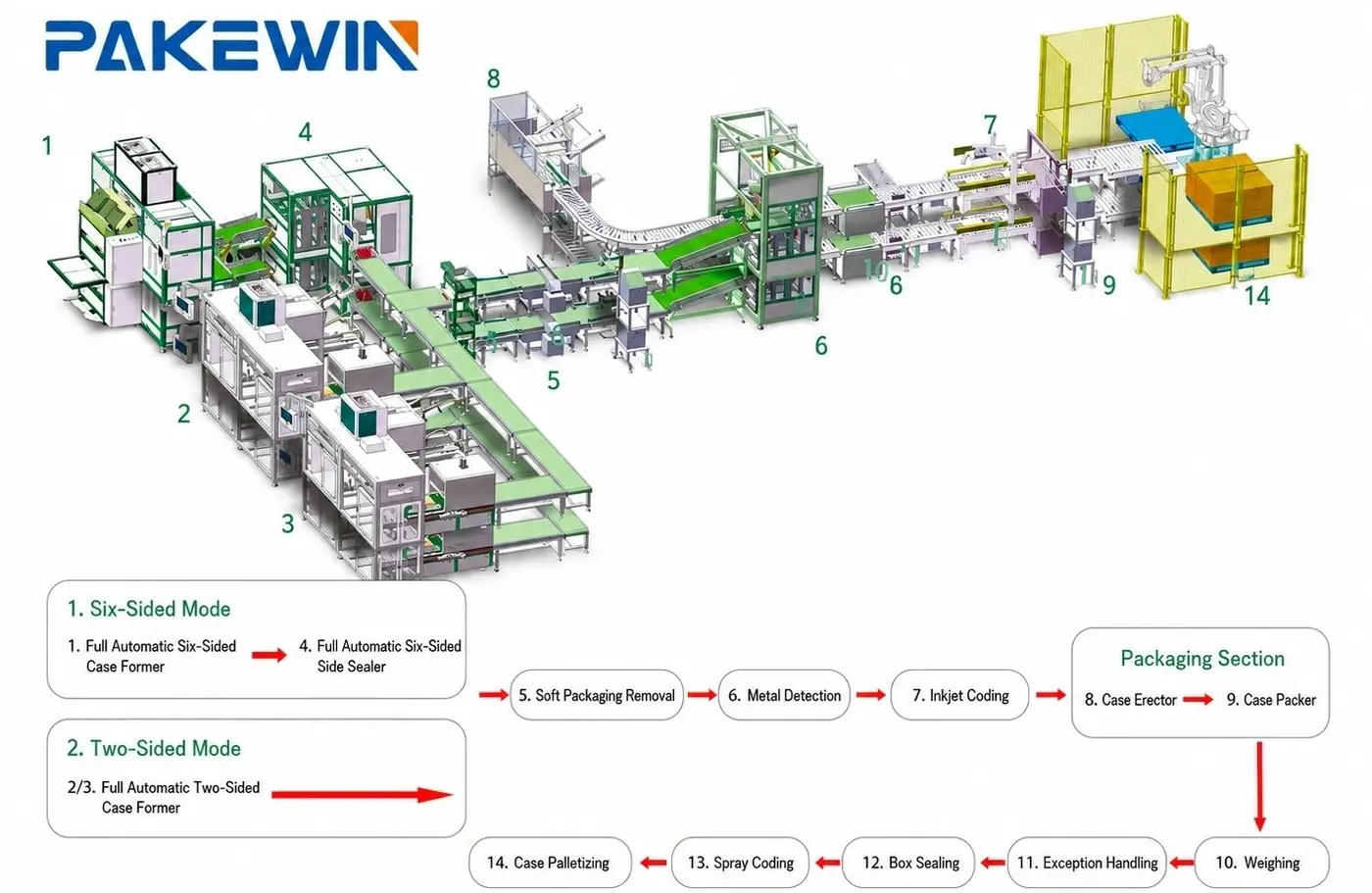
*Layout illustration of one packaging-line arrangement. It is not the proposed layout or a performance guarantee for a 25 kg bag project.*
5. Decide How the Cell Connects to Existing Equipment
An operator-assisted bagger can feed a robotic palletizer. For example, the PAK-BGS50 rice and grain bagging machine covers a stated 5–50 kg packing range, with operator bag placement. Its published 500–1100 bags/hour range needs confirmation for the actual product and workflow.
Automation at the palletizing stage does not remove upstream bag-placement tasks. Define the remaining operator duties, full-pallet removal and empty-pallet supply.
For a more automated upstream process, review the PAK-AFG25 automatic packing machine or PAKEWIN's automatic packaging lines. Match output across filling, closing, conveying, inspection and palletizing.
6. Compare Complete Installed Scope
Ask whether the quotation includes the robot, gripper, infeed conditioning, conveyors, guarding, controls, pallet stations, installation and training. Define access for clearing faults and changing pallets. Cell safety requires application-specific engineering and applicable local requirements; a demonstration without guarding is not a complete cell specification.
For overseas projects, specify supply voltage, frequency, documentation language, destination requirements, commissioning responsibilities, spare parts and remote-support arrangements.
Payback should use verified labor hours removed or redeployed and realistic operating costs. Include gripper wear, maintenance, utilities and support. Do not count extra production as a benefit unless the business can use or sell it.
What to Test Before Shipment
Agree a factory acceptance test using the intended product, bags and pallet pattern. Test sustained accepted output, grip reliability, bag damage, full-stack stability, format changes, stop-and-restart recovery and pallet exchange. Record exclusions and any conditions that still require site testing.
Send These Details for a Palletizing Proposal
Send PAKEWIN your product, bag weights and filled dimensions, bag material, required bags/hour, pallet dimensions, layer pattern, stack height, current conveyor video and available layout. Include utilities, destination country and planned pallet exchange method.
Request a bag palletizing configuration. An initial review can identify the information and sample testing needed for a suitable system proposal.
Frequently Asked Questions
Can a robot palletize 25 kg rice or grain bags?
Yes, with a suitable robot, gripper, bag presentation system and pallet pattern. Validate the actual filled bag and required sustained output.
Can robotic palletizing be added to a semi-automatic packing machine?
Yes. The interface needs appropriate conveying, spacing, control signals and buffering. Operator bag placement and other upstream tasks may remain.
How much robot payload is needed for 25 kg bags?
Add the weight of all bags handled per pick to the complete gripper weight, then check load centre, inertia and motion limits. There is no universal rating based only on bag weight.
Is catalogue cycle speed the same as bags per hour?
No. Actual bag throughput depends on bags per pick, motion paths, pickup conditions, layer patterns and pallet exchange. Specify the complete-cell production test.
Does AI make a bag palletizer more accurate?
AI may assist vision or fault analysis where specifically provided. Reliable stacking still depends on mechanical presentation, sensing, gripping and validated motion control. This article does not claim AI features for the EC-171.
Can the same cell handle different bag weights?
Possibly. Confirm the gripper range, bag presentation, recipes, payload and stack stability for every proposed format before purchase.